


Word of the Week for Students: A Simple Classroom Vocabulary Routine
Looking for an easy and meaningful way to build vocabulary? A word of the week for students is one of the simplest routines that can transform how children think, speak, and write.
While a word of the day for students can be effective, many teachers find it rushed and hard to sustain. A weekly approach creates space for deeper understanding, stronger connections, and real language growth.
Whether you’re teaching in a classroom, homeschooling, or working online, simple vocabulary routines can spark curiosity, boost confidence, and make writing and speaking feel more natural and expressive.

I started using a word-based routine because I wanted something easy, consistent, and engaging—and honestly, it completely transformed how my students interacted with words. Just a few focused minutes each day opened the door to deeper conversations, better writing, and a genuine love for language.
That’s exactly why we created the Word of the Week Slides, to make it effortless for teachers and families to bring that same magic into their own learning spaces.
A word of the week for students helps:
✅ Build stronger vocabulary naturally
✅ Improve writing and speaking skills
✅ Encourage deeper thinking
✅ Spark curiosity about language
Why Vocabulary Routines Matter
Language is more than a subject; it’s the foundation for how children express their understanding of the world. In Montessori education, the Language Curriculum connects beautifully to all other areas—geometry, history, biology, even grace and courtesy. The right vocabulary can help a child describe, categorize, and think critically.
But vocabulary growth doesn’t come from lists alone. It flourishes when words are presented in context and revisited often.
That’s where the Word of the Day week routine shines. It transforms vocabulary into a consistent practice of noticing, wondering, and applying. Students begin to see words not as tasks to memorize, but as tools to explore ideas.

From “Word of the Day” to “Word of the Week”
If you’ve ever tried a word of the day for students and found it hard to keep up, you’re not alone. Daily routines can feel rushed—especially when you’re balancing multiple subjects, transitions, or small group lessons.
That’s why shifting to a word of the week for students can be so powerful.
Instead of moving quickly through multiple words, this approach slows down and goes deeper. Students have time to:
➡️ Notice the word in books, lessons, and conversations
➡️ Use it in writing and storytelling
➡️ Explore its meaning, origin, and part of speech
➡️ Discuss how it connects to real life
This rhythm encourages both repetition and reflection, the perfect combination for lasting learning.

The Montessori Connection
In Montessori classrooms, language learning follows a natural progression: from concrete to abstract, from spoken word to written expression. Vocabulary lessons are woven into every area of study, and they often emerge organically from what the child is exploring.
For example:
🌱 During a science lesson on botany, you might introduce photosynthesis.
🌏 While studying geography, peninsula or archipelago could become your focus words.
📝 In literature discussions, courage, gratitude, or curiosity can become shared words of reflection.
A word of the week for students aligns beautifully with this philosophy—it’s not an isolated task, but a meaningful extension of learning.
What Makes a Good Word of the Week for Students?
Choosing the right words matters. You want vocabulary that sparks conversation and stretches students just enough.
Here are a few guidelines:
➡️ Relevance: Pick words that connect to your current theme or unit.
Example: During a unit on ecosystems, choose “symbiosis” or “habitat.”
➡️ Curiosity Factor: Select words that sound interesting or have layered meanings.
Example: “Resilient,” “wonder,” “transform.”
➡️ Usability: Make sure it’s a word students can actually apply in writing or discussion.
Example: “Observe,” “compare,” “predict.”
➡️ Mix It Up: Include a balance of academic and emotional vocabulary.
Example: “Adaptation” one week, “empathy” the next.

How to Use Our Word of the Week Slides
Our Word of the Week Slides are designed to make this routine simple and engaging.
Start with the Weekly Word
Display the word at the beginning of the week. Invite students to pronounce it, predict its meaning, or share where they might have heard it before.
Read and Explore Together
Each slide includes a student-friendly definition, part of speech, and an example sentence. Use this as a starting point for discussion and deeper thinking.
Use the Visual
Each slide includes a visual to support comprehension. In Montessori environments, this helps connect abstract vocabulary to real-world meaning.
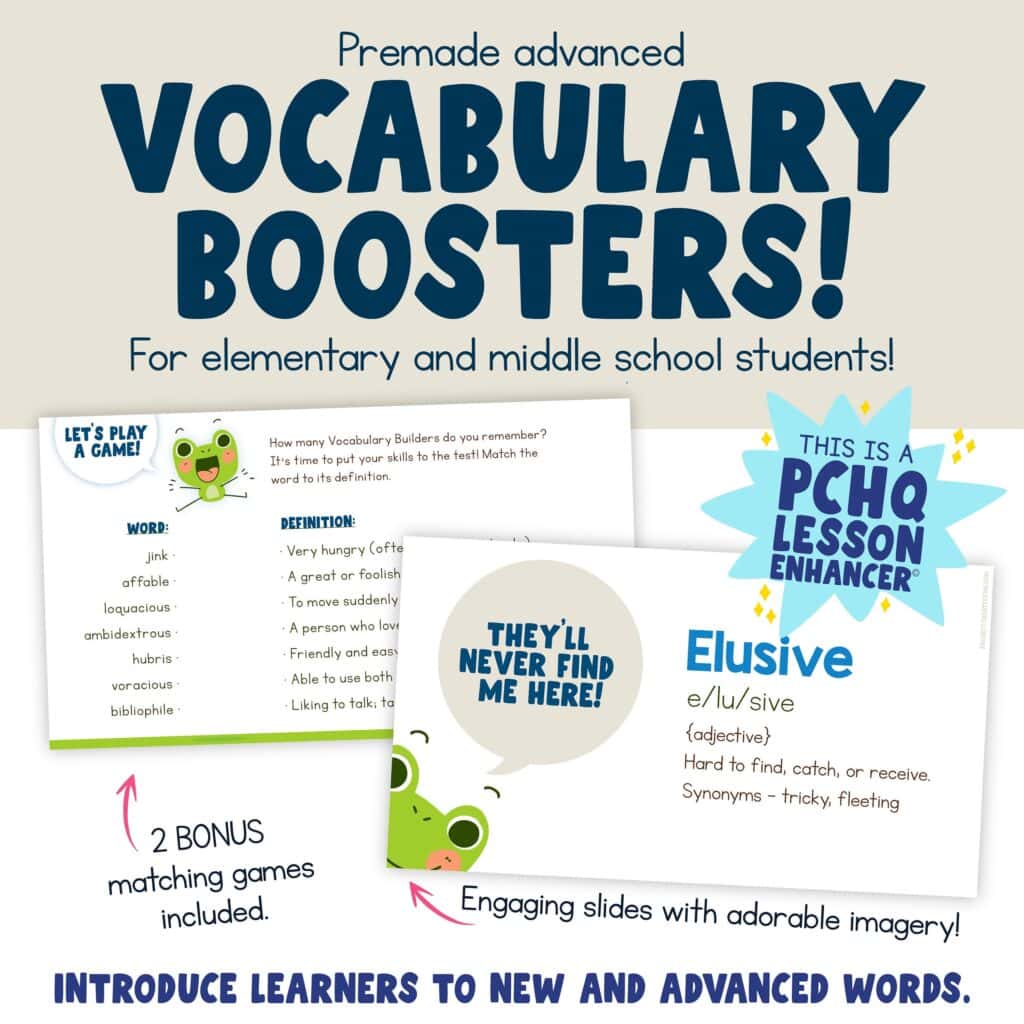
Find all our vocabulary building products here. 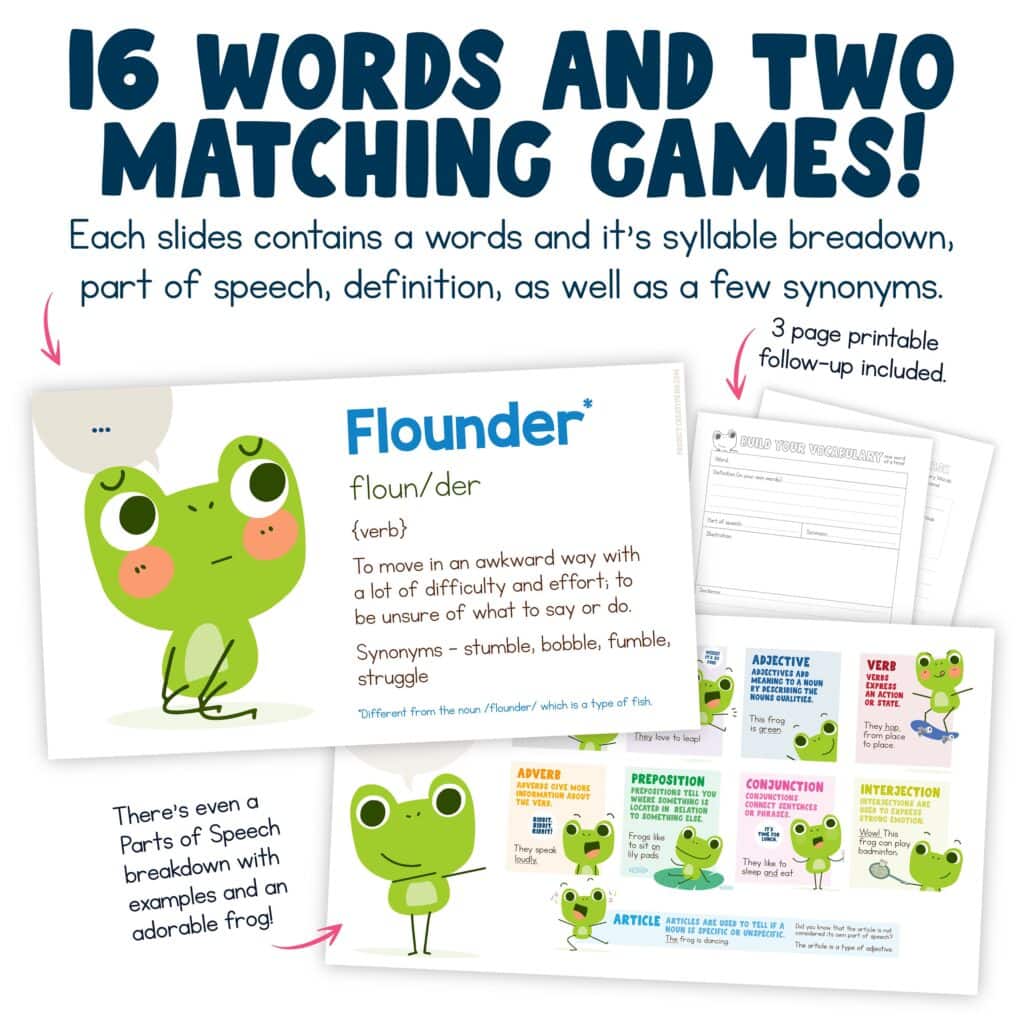
Find all our vocabulary building products here. 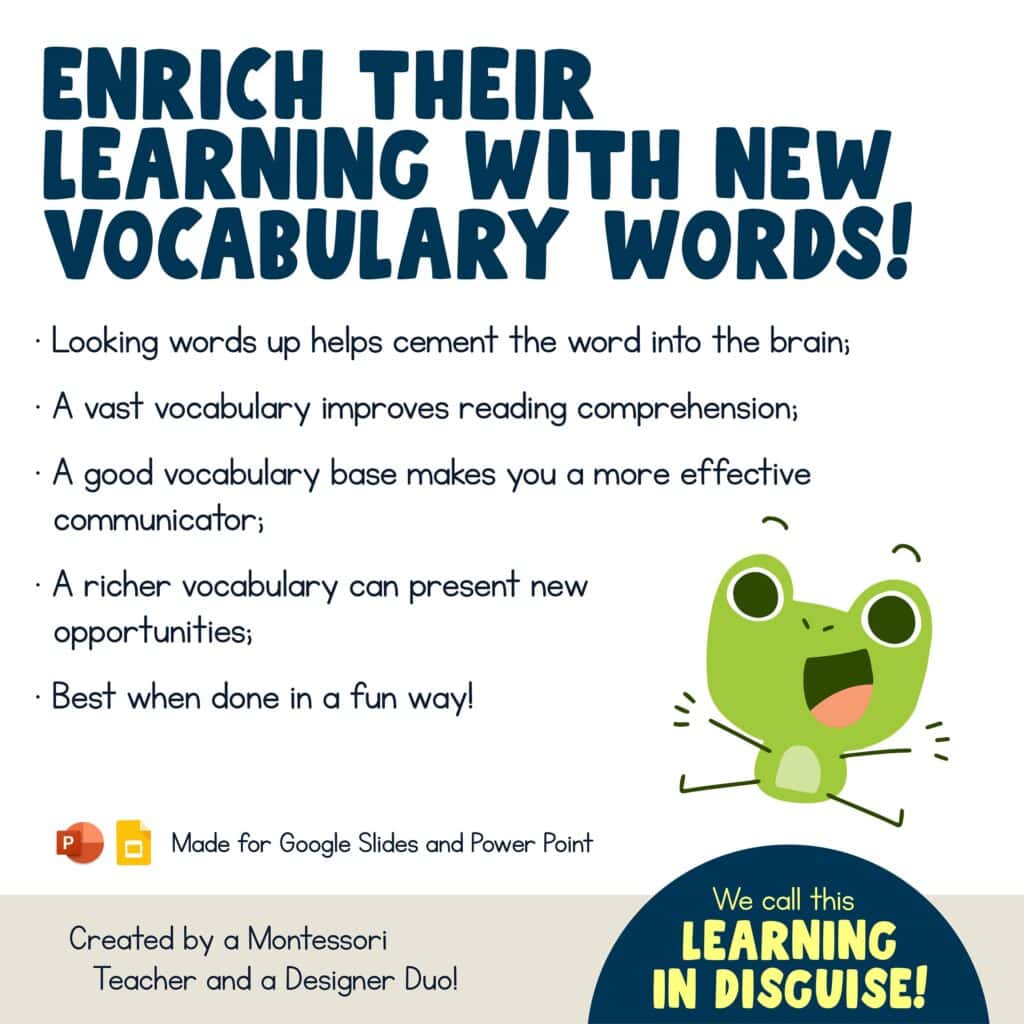
Find all our vocabulary building products here. 
Find all our vocabulary building products here. 
Find all our vocabulary building products here.
Reflect and Apply
Use prompts like these to spark deeper thinking:
💡 “How does this word connect to our theme this month?”
💡 “Where might we see or use this word in real life?”
💡 “What’s another word that means something similar?”
Review and Revisit
At the end of the week have a class meeting and invite students to share how they used the word—in writing, conversation, or observation. Add it to a word wall or vocabulary journal to reinforce learning.
Classroom Ideas to Extend Your Word of the Day for Students Routine
Keep your word of the week for students routine engaging with these simple extensions:
Word Art Posters
Students illustrate the word with visuals, synonyms, and examples.
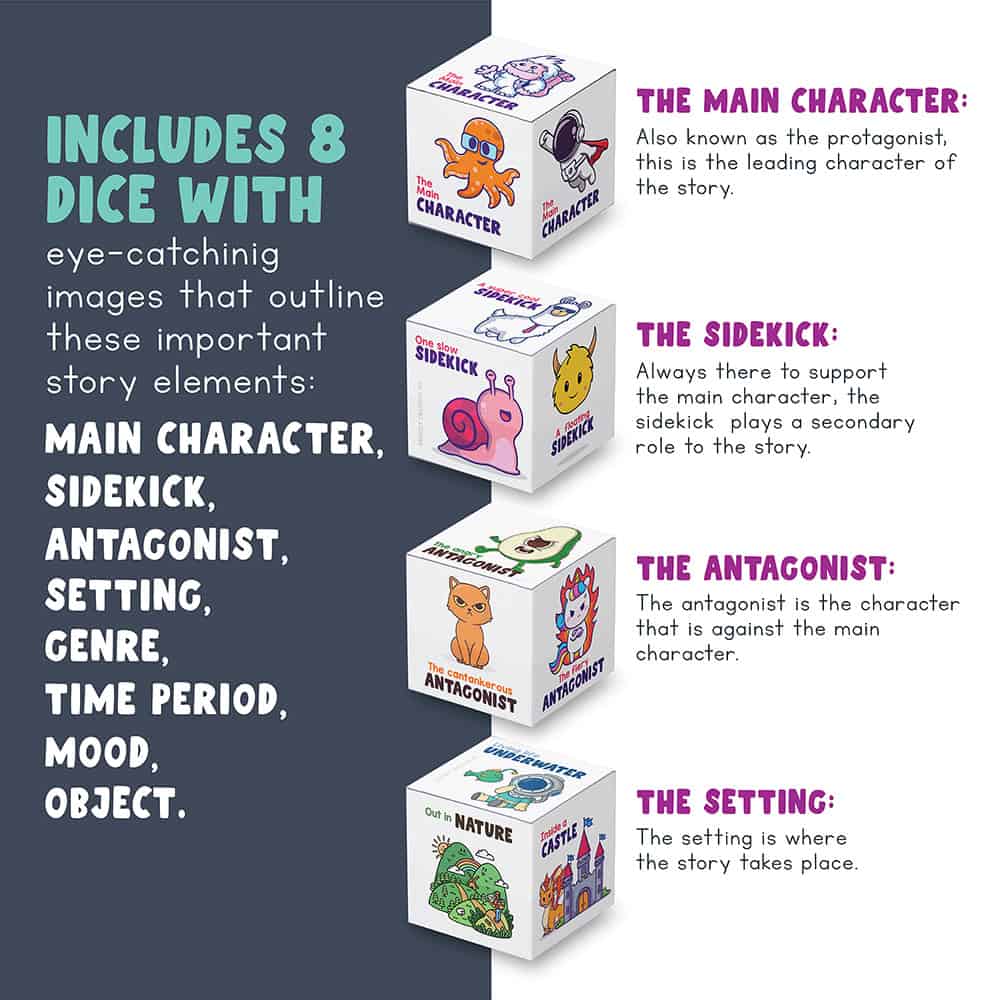
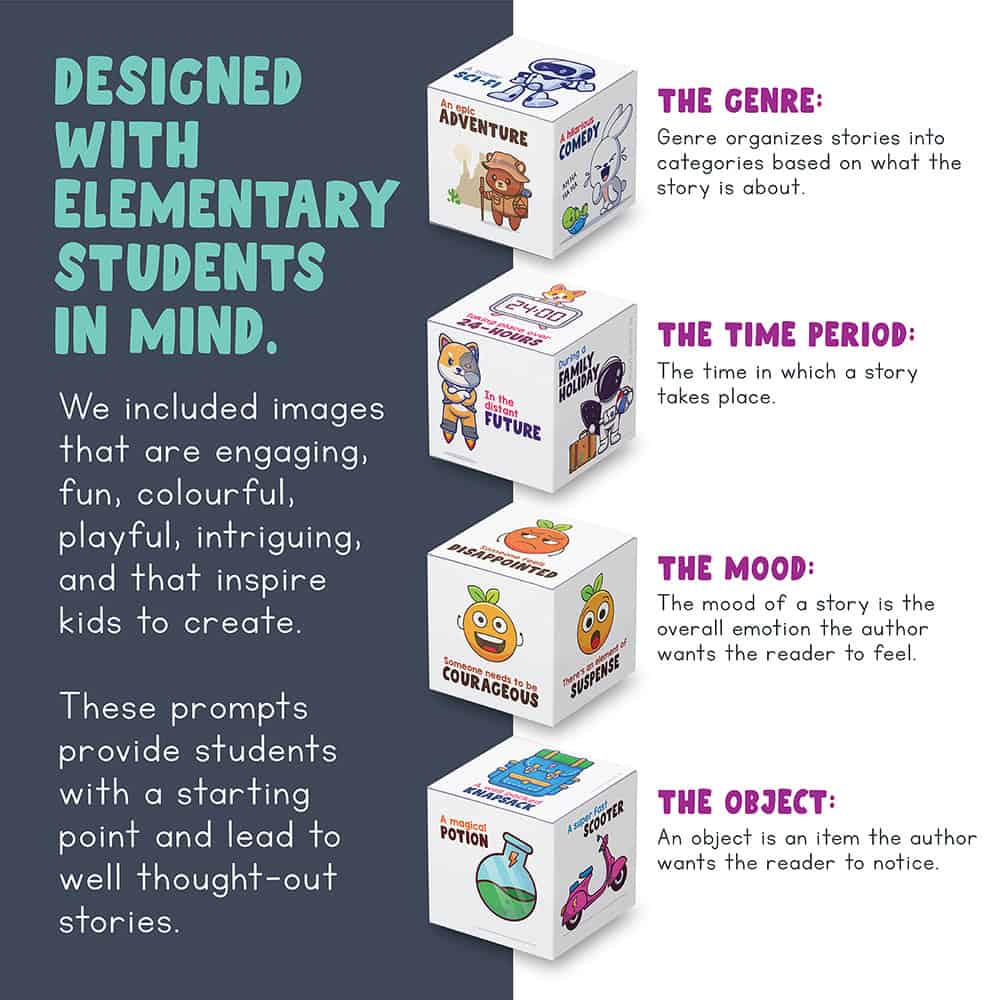
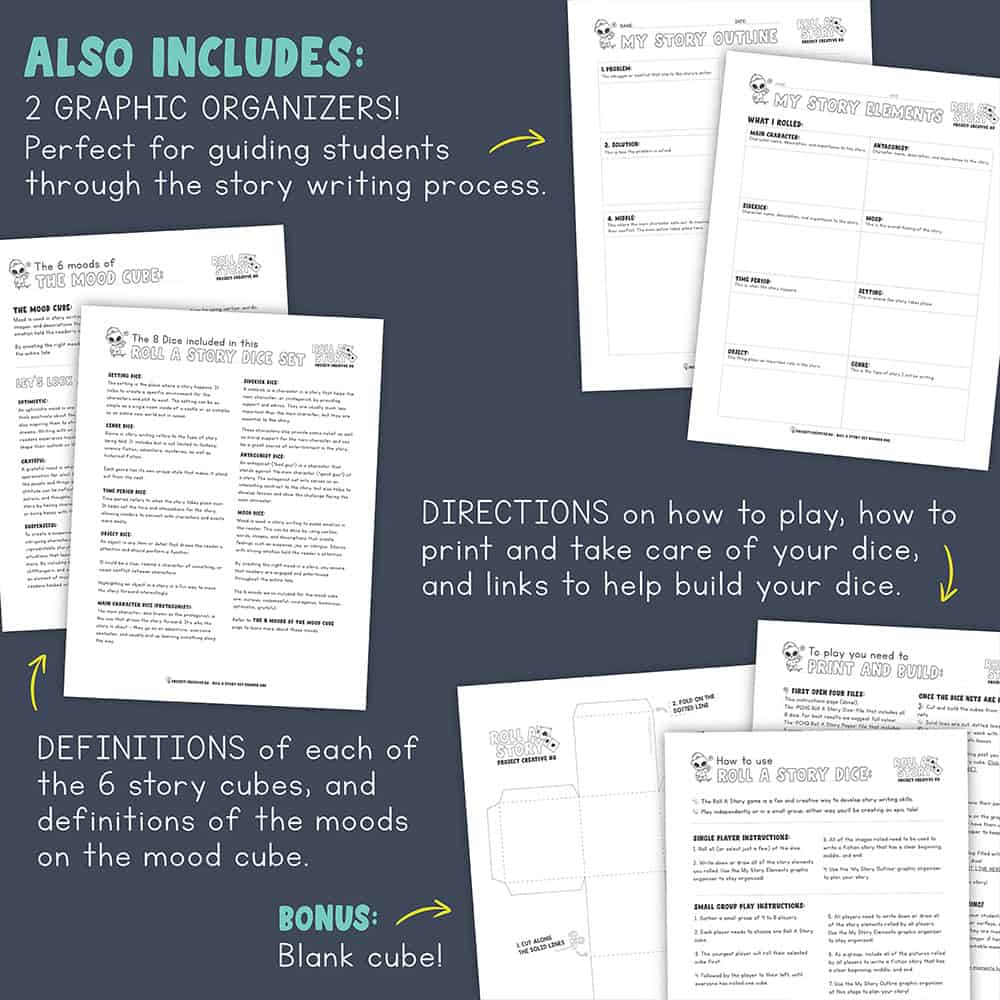
Story Dice Challenges
Students roll story dice and create a short story using the word of the week. Our Story Dice make this easy and fun, adding just enough randomness to spark creativity and deeper language use.

Vocabulary Journals
Students record each word with definitions, sentences, and reflections.
Word Scavenger Hunts
Students look for the word in books, conversations, or daily life.
Synonym Chains
Build a chain of related words (content → happy → cheerful → joyful).
Sentence Challenges
Have students write stories, poems, or comics using the weekly word.
Grace and Courtesy Connection
Incorporate social-emotional words like respect, patience, or kindness.
FREE Social Skills Command Cards
Make social skills fun to learn with these engaging task cards!
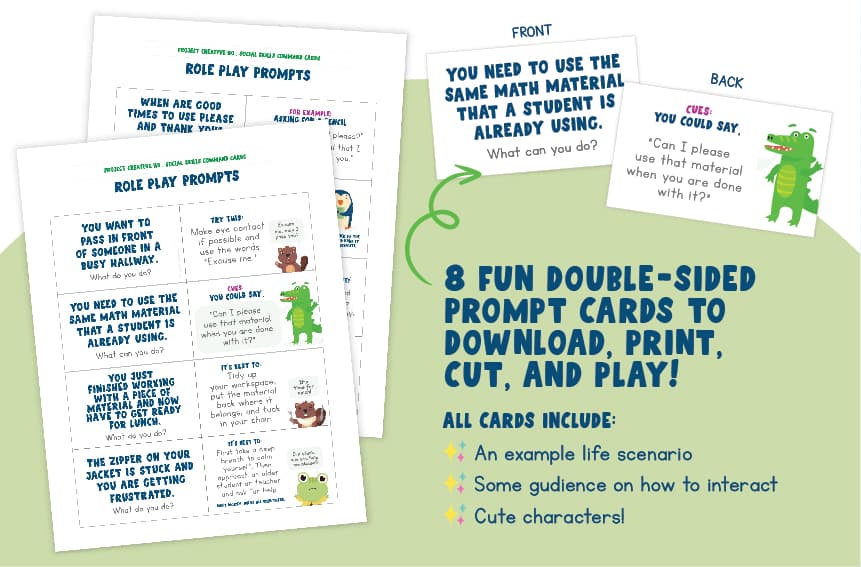
These double-sided prompts help kids practice taking turns, managing emotions, and reading body language through role-play. Perfect for building strong classroom and home relationships.
📥 Sign up for our newsletter and get them for FREE!
How a Word of the Week for Students Builds Communication Skills
Language confidence grows through small, repeated moments of practice.
With a word of the week for students, learners begin to:
💡 Speak with precision
💡 Write with confidence
💡 Listen for meaning
💡 Think more deeply
These are skills that transfer across every subject and life experience.

Over time, students naturally start using new vocabulary in conversation.
One week, I introduced the word churn, and by the end of the week, students were using it everywhere—during gym, at lunch, and in completely unexpected ways. That’s when you know the learning has truly stuck.
Supporting All Learners
This routine is easy to adapt:
✅ Ages 6–8: Focus on concrete, visual words (nouns, verbs, adjectives)
✅ Ages 9–12: Introduce abstract terms, roots, and deeper meanings
✅ ELL learners: Use visuals, repetition, and home-language connections
A shared word of the week for students can support a wide range of learners while still meeting individual needs.
Making It Joyful, Not Rote
The goal isn’t memorization, it’s exploration.
Let students bring words from their own experiences. Follow their curiosity. When language feels meaningful, students don’t just learn new words—they begin to love them.
Ready to Try It?
If you’ve been wanting to start a vocabulary routine, this is a simple place to begin.
Our Word of the Week Slides make it easy to build consistency without adding extra prep.
Perfect for:
✅ Morning meetings
✅ Literacy blocks
✅ Online learning
✅ Elementary classrooms
✅ Homeschool families
Each set is ready to use and adaptable to your learners.
The Wrap-Up: Word of the Week for Students
Language shapes how children think, communicate, and understand the world. By introducing a word of the week for students, you’re giving them more than vocabulary—you’re building confidence, curiosity, and connection.
So choose your next word, display it proudly, and invite your students to explore it.
Because one word at a time, they’re building a lifelong love of language.
📌 Pin this blog so you can easily find it when you’re ready to teach vocabulary!

FAQs About Word of the Week for Students
What is a good word of the week for students?
A good word of the week for students is meaningful, relevant, and easy to apply in real contexts. Words like observe, resilient, compare, or gratitude work well because students can use them throughout the week.
How do you teach vocabulary in a Montessori classroom?
Vocabulary is introduced through real experiences and meaningful context, then reinforced through conversation, hands-on work, and repetition. A word of the week fits naturally by allowing time for exploration and application.
Should I use word of the day or word of the week?
Both can work, but a word of the week for students allows for deeper learning. While a word of the day offers frequent exposure, a weekly focus gives students time to fully understand, use, and retain the word.
💡 Check out the learning activities in these blogs:
21 Creative Parts Of Speech Activities Your Students Will Love
Story Dice: A Fun Story Prompt Game Kids Love
Rebus Puzzles for Kids: A Comprehensive Riddle-Solving Guide
31 Fun Summer Reading Activities Elementary Students Will Love
The Best Neighborhood Walk Scavenger Hunt
