


Grammar Games That Bring Language to Life in the Classroom
If grammar feels like a battle in your classroom, it’s not because your students “don’t get it.” It’s because grammar was never meant to be taught sitting still. When I taught Montessori elementary, grammar finally made sense when students could move, build, sort, and play with language. That’s where hands-on grammar games changed everything.
These Montessori-inspired grammar games are the ones I used again and again with lower and upper elementary students. They’re practical, engaging, and designed to make grammar stick—without worksheets, boredom, or constant reteaching.

Grammar Games for Lower Elementary
Ages 6–9 | Concrete, hands-on grammar work with movement, objects, and exploration
Grammar Farm
Grammar Focus: Nouns, adjectives, verbs, sentence building
Materials:
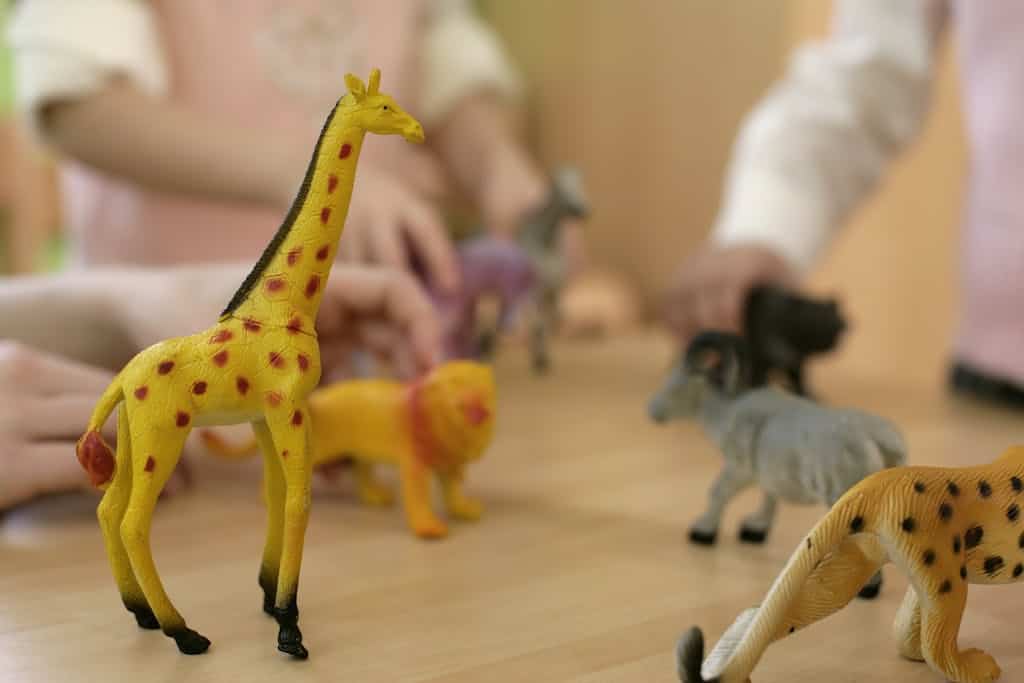
- A variety of animal miniatures/figurines
- Montessori grammar symbols (optional)
- Word cards or sentence strips
How to Play:
Children choose an animal miniature and create a phrase or sentence using word cards or sentence strips (e.g., The tall giraffe has brown spots). They can also place Montessori grammar symbols above each word to label its function, adjusting or expanding the sentence as they go.
Why It Works:
This game grounds abstract grammar concepts in real-world, tactile play—helping children internalize parts of speech through movement, choice, and context.
Extension:
Invite children to swap miniatures or add descriptors to build longer, more complex sentences.
Elbow Macaroni Commas
Grammar Focus: Commas, sentence structure, parts of speech
Materials:
- Sentence strips or written sentences (no punctuation)
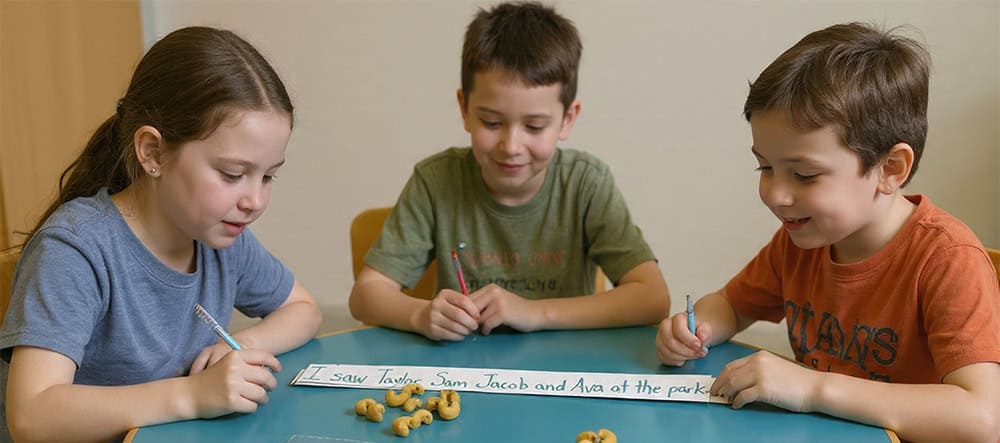
- Dry elbow macaroni
- Montessori grammar symbols (optional)
How to Play:
Present children with long, unpunctuated sentences. Children place elbow macaroni where they believe commas belong, then read the sentence aloud to check for clarity and meaning. Finish by analyzing each word using grammar symbols.
Why It Works:
By making punctuation physical and visible, this activity supports kinesthetic learners and helps children develop a stronger sense of sentence flow.
Extension:
Challenge students to rewrite the sentence using commas in a different way or to create their own comma-ready sentence for a classmate to solve.
Silly Sentence Builders
Grammar Focus: Parts of speech, sentence building
Materials:
- Color-coded word cards (sorted by part of speech)
- Sentence strip or workspace
- Montessori grammar symbols (optional)
How to Play:
Students draw one word card from each part-of-speech category and arrange them into a sentence—the sillier, the better. Once the sentence is complete, they label each word with the appropriate grammar symbol.

Why It Works:
Humor and creativity lower barriers, making it easier for children to experiment with language while reinforcing sentence structure.
Extension:
Invite students to add other parts of speech to expand their sentence, or trade one word card to see how changing a single part of speech affects meaning.
Preposition Treasure Hunt
Grammar Focus: Prepositions, sentence construction
Materials:
- Small objects to hide
- Preposition clue cards or sentence strips
- Paper and pencil
How to Play:
Hide small objects around the classroom and provide clue sentences using prepositions (e.g., under the mat, behind the easel). Students follow the clues to find the object. Have them write the prepositional phrase that helped them find the object.

Why It Works:
This scavenger hunt style activity turns abstract prepositions into real, physical experiences through movement and exploration.
Extension:
Have students create a multi-step treasure hunt for a partner or small group, using at least three different prepositions in sequence.
💡Get a Free Parts of Speech Chart
Sign up for our newsletter and receive a free, printable parts of speech chart you can use right away in your classroom or homeschool space.
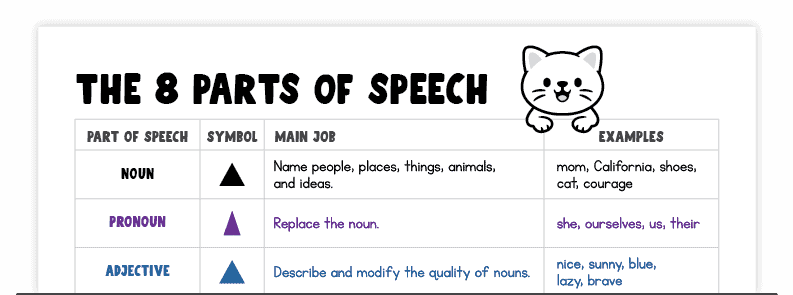
It’s a simple way to bring hands-on, visual learning to your students—plus you’ll get ongoing access to elementary resources, teaching tips, engaging activities, and exclusive freebies from us.
Action Verb Charades
Grammar Focus: Action verbs, sentence building
Materials:
- Verb cards (in a hat or basket)
- Paper and pencil
How to Play:
A student draws a verb card and acts it out while classmates guess the action. Once the verb is identified, each student writes a complete sentence using that verb.

Why It Works:
Whole-body movement helps children internalize verb meaning while connecting action to written language.
Extension:
Invite students to change the verb tense or add adverbs to the sentence and discuss how the meaning shifts.
Adjective Art Gallery
Grammar Focus: Adjectives, descriptive writing
Materials:
- Drawing or painting supplies
- Paper
- Montessori grammar symbols
How to Play:
Students create an original piece of art, then write three sentences describing their work using at least two adjectives per sentence. Then have them choose one sentence to analyze and identify the part of speech of each word with the appropriate grammar symbol.

Why It Works:
Pairing visual art with language encourages richer vocabulary while helping students see adjectives as purposeful tools, not extras.
Extension:
Invite students to revise one sentence by swapping adjectives or adding stronger descriptive words, then compare how the meaning and tone change.
Noun Sort Basket
Grammar Focus: Nouns and noun categories
Materials:
- Basket of small objects and photo cards
- Sorting labels (person, place, thing, animal, idea)
- Montessori grammar symbols
How to Play:
Students sort objects and photos into noun categories. Once sorted, they can explain their thinking aloud or in writing.

Why It Works:
Handling real objects helps make abstract noun categories concrete and accessible for early grammar learners.
Extension:
Challenge students to create a sentence using one noun from each category or to add written labels for abstract nouns represented by pictures or scenarios.
Sentence Strip Switch-Up
Grammar Focus: Parts of speech, sentence structure
Materials:
- Sentence strips with missing words
- Word cards or magnets (sorted by part of speech)
- Montessori grammar symbols
How to Play:
Present students with sentence strips missing one or more parts of speech. Students choose word cards or magnets to complete each sentence, then read it aloud to check for meaning. Once satisfied, they label the completed sentence using grammar symbols.

Why It Works:
This activity invites children to manipulate language directly, strengthening grammar awareness through choice, experimentation, and immediate feedback.
Extension:
Have students create their own incomplete sentence strips for a partner to complete, adjusting the difficulty by leaving out different parts of speech.
Grammatical Games for Upper Elementary
Ages 9–12 | Deeper grammar exploration, abstraction, and application
Grammar Detective
Grammar Focus: Editing, sentence structure, conventions
Materials:
- Short paragraphs or “mystery” passages with grammar errors
- Editing pencils or highlighters
- Montessori grammar symbols
How to Play:
Present students with a short passage filled with grammar errors. Working in pairs, students identify and correct the mistakes, then use grammar symbols to explain why each change was necessary.

Why It Works:
This activity builds editing skills while encouraging peer discussion and deeper reasoning about how grammar functions in real writing.
Extension:
Have students write their own error-filled paragraph for another pair to analyze and correct.
Sentence Surgery
Grammar Focus: Articles, modifiers, sentence clarity
Materials:
- “Sick” sentence strips with grammar issues
- Tweezers or small tools
- Blank sentence strips
- Montessori grammar symbols
How to Play:
Students receive a flawed sentence and “operate” by removing, rearranging, or replacing words to improve clarity and correctness. Once reconstructed, they analyze the sentence using grammar symbols.

Why It Works:
The tactile, problem-solving approach strengthens editing instincts while making abstract grammar concepts concrete and engaging.
Extension:
Challenge students to create multiple revised versions of the same sentence and compare how meaning or tone changes.
Build-a-Story Grammar Relay
Grammar Focus: Parts of speech, sentence variety, collaboration
Materials:
- Sentence starter cards
- Grammar focus spinner or cards (e.g., adjective, adverb, conjunction)
- Paper or whiteboard
How to Play:
In small groups, students take turns adding one sentence at a time to a shared story. Before writing, they spin or draw a grammar focus card that determines which part of speech must be emphasized.

Why It Works:
This game combines creativity, collaboration, and intentional grammar practice—helping students apply grammar skills in authentic writing.
Extension:
Require students to revise the final story by identifying one sentence to strengthen using a different grammatical focus.
Parts of Speech Debate
Grammar Focus: Parts of speech, context, sentence meaning
Materials:
- List of multi-use words (e.g., light, fast, play)
- Chart paper or whiteboard
- Montessori grammar symbols
How to Play:
Present a word that can function as more than one part of speech. Students discuss and debate how the word changes depending on context, then write multiple example sentences and label each word with grammar symbols.

Why It Works:
This activity reinforces the idea that grammar is flexible and meaning-driven, pushing students to think critically about how language functions.
Extension:
Have students bring their own “tricky” words to the debate and justify their classification using evidence from their sentences.
Grammar Symbol Codebreaker
Grammar Focus: Parts of speech, sentence construction
Materials:
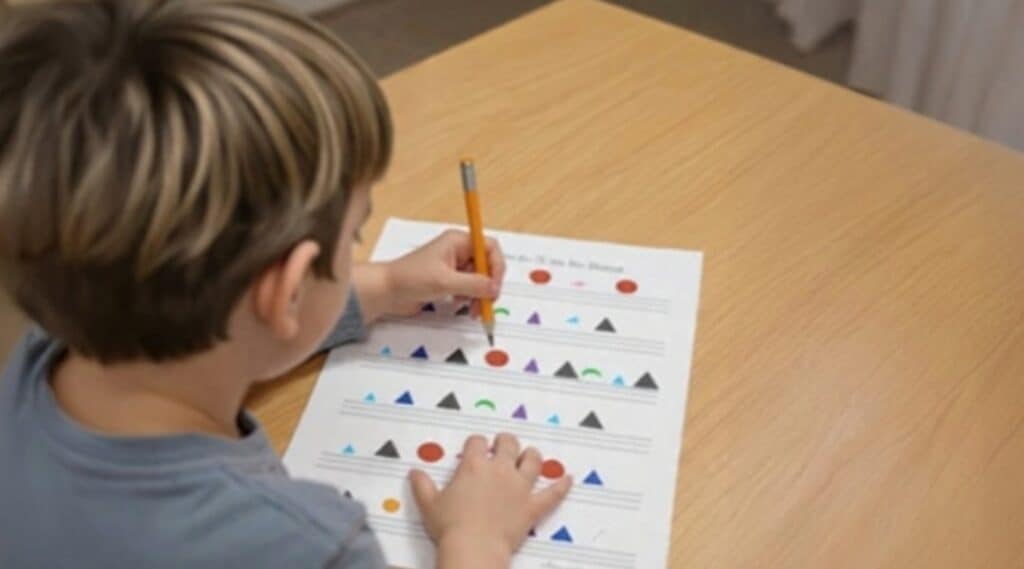
- Sentences written entirely in grammar symbols
- Paper and pencil
- Montessori grammar symbols reference chart
How to Play:
Students receive a sentence made only of grammar symbols and decode it by replacing each symbol with an appropriate word. They then write the completed sentence and read it aloud, checking for clarity and correctness.
Why It Works:
By stripping language down to its structure, students deepen their understanding of how parts of speech work together.
Extension:
Invite students to create their own symbol-only sentences for classmates to decode.
Advanced Preposition Map
Grammar Focus: Prepositions, descriptive language
Materials:
- Detailed maps or illustrated scenes (parks, neighborhoods, rooms)
- List of prepositions
- Paper and pencil
- Montessori grammar symbols
How to Play:
Using the map or scene, students write descriptive sentences that include multiple prepositions (e.g., between, beyond, along). They then analyze each sentence using grammar symbols.

Why It Works:
This activity blends grammar with spatial reasoning, helping students apply prepositions in meaningful, real-world contexts.
Extension:
Challenge students to write a short paragraph that uses at least five different prepositions without repeating any.
Verb Tense Timeline
Grammar Focus: Verb tenses, helping verbs, time relationships
Materials:
- Event cards (historical or fictional)
- Timeline strip or chart paper
- Paper and pencil
- Montessori grammar symbols
How to Play:
Give students an event and have them write three versions of the same sentence—one in past tense, one in present tense, and one in future tense. Students place each sentence on a timeline and label the verbs and helping verbs with grammar symbols.

Why It Works:
Seeing sentences placed along a timeline helps students internalize how verb tenses shift meaning and signal time relationships in writing.
Extension:
Ask students to convert their sentences into perfect or progressive tenses, comparing how the nuance changes depending on the tense used.
Sentence Transformation Challenge
Grammar Focus: Parts of speech, sentence expansion, syntactic flexibility
Materials:
- Simple base sentences
- Paper and pencil
- Montessori grammar symbols
How to Play:
Start with a basic sentence (e.g., “The dog ran.”). Students take turns transforming the sentence by adding, replacing, or rearranging parts of speech to make it more precise, descriptive, or complex. Each version is labeled with grammar symbols and discussed.

Why It Works:
Students see how grammar choices directly shape meaning, complexity, and style—an essential skill for upper elementary writers.
Extension:
Ask students to transform the same sentence for different purposes (story opening, informational writing, persuasive writing).
Benefits of Grammar Games in the Classroom
Grammatical games do more than just make learning fun—they support the core Montessori principles of hands-on discovery, independence, and meaningful repetition. Here’s why they’re such a powerful tool:
Grammar Games Make Abstract Concepts Concrete
Grammar can feel invisible to children, but games turn it into something they can see, touch, and manipulate. This concrete experience helps solidify understanding, especially for visual and kinesthetic learners.
They Encourage Exploration and Choice
Many grammatical games invite children to choose words, rearrange sentences, or solve puzzles, which fosters independence and critical thinking—key components of the Montessori approach.

Grammar Games Reinforce Through Joyful Repetition
Games naturally lead to repetition, but in a way that feels fresh and engaging. Repeated exposure through play deepens mastery without the need for rote memorization.
These Activities Build Collaboration and Communication
Group games and partner activities support social development while encouraging students to explain their thinking and learn from one another.
Grammar Games Boost Confidence with Language
By playing with language in a low-pressure environment, students develop confidence in using grammar correctly, which carries over into their writing and speech.
The Wrap-Up: Grammar Games for Elementary Students
When I taught Montessori elementary, I quickly learned that grammar comes alive when students can move, talk, create, and explore. That’s why I leaned so heavily on grammar games—they gave my students the chance to internalize language concepts in ways that felt joyful, meaningful, and totally hands-on.
If you’re looking to breathe new life into your grammar lessons, try one of these games this week. I think you’ll be amazed by how quickly your students engage, experiment, and light up the moment grammar becomes something they can do, not just something they’re told.
📌 Save this pin for easy, go-to grammar games all year long.

💡Supplement parts of speech lessons with these products:
Animal Matching and Memory Game
Parts of Speech Game
Parts of Speech Posters
Parts of Speech Montessori Grammar Symbols Poster
Vocabulary Graphic Organizer
